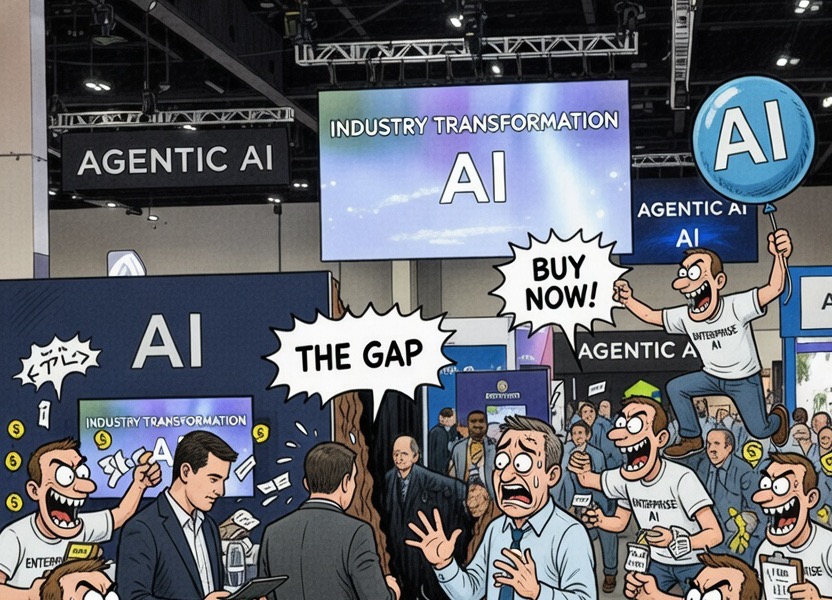
Every vendor at Manifest 2026 was talking about what their AI can do. Almost none were talking about whether anyone is actually using it.
I spent the week walking the floor in Vegas. The slides were polished. The buzzwords were flying. "Agentic AI," "industry transformation," "P&L impact." But talk to the people who actually run warehouses, manage fleets, and coordinate supply chains, and you hear a different story. They're not skeptical about AI. They're overwhelmed by it.
The gap between what AI can do and what people are actually doing with it — that's the real opportunity.
The Problem Isn't the Technology
The technology works. AI agents can reason across systems, handle exceptions, and take action autonomously. The problem is adoption. And adoption isn't a technology problem — it's a human problem.
At Manifest I kept hearing the same thing: operators who know AI matters but don't know where to start. Logistics managers who can't picture it in their operation. IT leaders burned by "transformational" technology that never made it past the pilot.
So let me show you what it actually looks like.
Three Prompts That Replace Three Hours of Work
The safety manager used to spend their morning pulling incident reports, cross-referencing names, and trying to spot patterns across shifts. Now they type:
"Tell me about employees with repeat safety issues. For every employee with more than 3 safety events in the past week, reach out to their supervisor with a tailored coaching plan. Anyone with more than 7 events in the timeframe, please refer to HR."
The AI agent pulls the data, identifies the patterns, drafts the coaching plans, and routes them — before the manager finishes their coffee.
The ops director used to dig through reports trying to figure out why margins were thin on certain accounts. Now:
"Which of our customers has the highest cost to serve? Why? If it's zoning or layout related, propose a new setup that reduces cost to serve based on travel distance."
The claims coordinator used to spend half a day chasing down what happened to a damaged shipment — calling the dock, pulling camera footage, tracking down paperwork. Now:
"We just got a claim from our client for order #11SA887. Trace every pallet on that outbound and send me videos of the loading sequence."
These aren't hypotheticals. These are real prompts running in real warehouses today. And they didn't require a six-month implementation to get there.
The Mindset Shift
Here's the thing nobody is teaching people: before you do the thing you do every morning — pull the report, download the files, triage the emails — ask AI if it can do it first.
That's it. That's the whole behavior change.
Not "transform your organization." Not "reimagine your workflows." Just pause before the repetitive stuff and ask: can AI do this for me?
Most of the time the answer is yes. And once someone sees that — once they get back an hour of their morning — they start asking the question about everything. That's when adoption takes off. Not from a top-down mandate. From a person who got their time back and told the person next to them.
Why It Stalls
If it's that simple, why isn't everyone doing it? Because the industry is making it harder than it needs to be.
Fear. The expo floor messaging — AI replacing every human in the supply chain — terrifies the people who actually need to adopt the tools. Without their buy-in, nothing works.
Complexity. Too many AI solutions require a PhD to configure and a consulting engagement to implement.
Abstraction. "Industry transformation" means nothing to the warehouse manager trying to get through tomorrow's shift.
Trust. ERP was supposed to fix everything. IoT was supposed to fix everything. Blockchain was supposed to fix everything. The audience has been burned before.
The antidote to all four is the same: show people the actual thing. Not a slide. Not a roadmap. The actual AI, running on their actual data, solving their actual problems. Give them override controls. Let them correct it. Make them the expert training the AI, not the worker being replaced by it.
The Real Metric
How many people in your operation are using AI today that weren't yesterday? If the answer is zero, the most powerful AI in the world is generating exactly zero value.
The companies that win the next decade of logistics aren't the ones with the best AI. They're the ones that got the most people using it, in the most places, every day.
The technology is ready. The question is whether you'll meet your people where they are — or keep waiting for "transformation" to happen on its own.
Book 30 minutes with us and we'll show you the exact prompts and workflows running in warehouses today — live, on screen, no slides. If you don't walk away with at least one thing you can use tomorrow morning, we'll buy the coffee.
Book your 30 minutes →
Related Articles
- What is Agentic AI? - Understanding the technology behind AI agents
- How AI Agents Optimize Your Forklift Fleet - A real agent in production
- AI Agents for Warehouse Operations - Deploying agents in the real world
- Agentic AI for Supply Chain - The complete guide to AI agents in supply chain
- From Drones to AI Agents: The OneTrack Founding Story - How we got here
- Code Story Podcast: The OneTrack Story - Marc shares the full journey