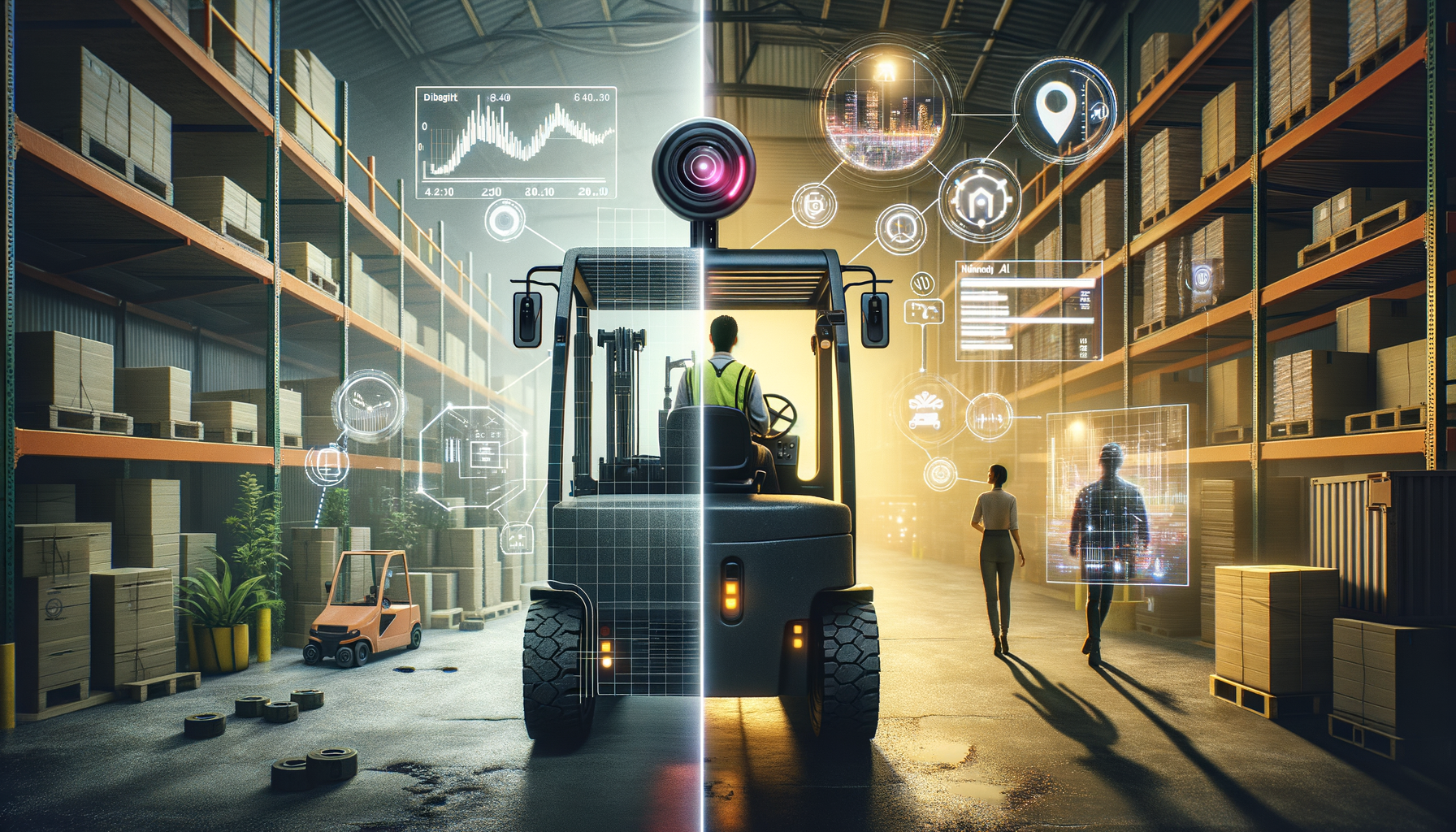
If you're researching forklift monitoring systems, you've probably come across two main approaches: traditional telematics and vision AI. Both promise to give you visibility into your forklift operations, but they work in fundamentally different ways and deliver very different results.
This guide breaks down what each technology actually does, where they overlap, and where they diverge. By the end, you'll know which approach fits your operation's needs.
What Forklift Telematics Actually Does
Forklift telematics systems have been around for decades. They use sensors mounted on your equipment to capture operational data points: GPS location, speed, G-force readings, runtime hours, and sometimes engine diagnostics.
The typical telematics setup includes:
GPS tracking to show where each forklift is located in your facility and create heat maps of travel patterns.
G-force sensors that trigger alerts when acceleration or deceleration exceeds a set threshold, indicating a potential impact.
Runtime monitoring that tracks when equipment is on, off, and how many hours it has been operated.
Speed monitoring to flag when operators exceed facility speed limits.
Some telematics systems also include access control features like RFID badges or PIN codes to track which operator is using which forklift. More advanced systems add engine diagnostics for maintenance planning.
This data gets sent to a central dashboard where you can pull reports, set alerts, and track trends over time.
The Limitations of Telematics Data
Telematics gives you data points. Lots of them. But data points without context often raise more questions than they answer.
Consider what happens when your telematics system sends a G-force alert. You know a forklift exceeded the threshold at 2:47 PM in aisle 12. What you don't know:
- Did the forklift actually hit something, or did it roll over a crack in the floor?
- If there was an impact, what did it hit? Racking, product, another forklift, a person?
- What was the operator doing in the moments before the event?
- Was this a careless mistake or a process problem that needs fixing?
Without answers to these questions, your options are limited. You can talk to the operator, who may not remember the specific incident or may have a different recollection of what happened. You can review CCTV footage, if you have coverage in that area and if you're willing to spend an hour scrubbing through video. Or you can just log the alert and move on, hoping it doesn't happen again.
The same problem applies to utilization data. Telematics can tell you a forklift was "running" for 6 hours yesterday. But what does "running" mean? Was the operator actively moving product, or sitting idle waiting for work? Was the lift engaged in productive tasks, or driving empty across the facility because of poor task assignments?
Telematics captures the "what" but misses the "why."
What Vision AI Does Differently
Vision AI systems use cameras mounted on forklifts combined with artificial intelligence to understand what's actually happening during operations. Instead of just recording sensor readings, vision AI interprets the scene and recognizes specific behaviors, objects, and situations.
Here's what that looks like in practice:
Behavior recognition: The AI identifies specific operator actions like phone use while driving, not looking in the direction of travel, hands off controls, eating or drinking, or not wearing required PPE.
Context capture: When an event occurs, you get video showing exactly what happened, including the seconds before and after. No guessing, no he-said-she-said.
Object detection: The system recognizes pallets, racking, pedestrians, other forklifts, debris on the floor, and other elements that affect safety and productivity.
Pattern analysis: Over time, the AI identifies trends in operator behavior and facility conditions that correlate with incidents.
The key difference is understanding versus measurement. Telematics measures forces and positions. Vision AI understands situations.
Head-to-Head: Impact Detection
Let's compare how each system handles a common scenario: a forklift impacts racking.
Telematics approach: The G-force sensor triggers when the impact exceeds your threshold. You get an alert with the time, location, operator ID, and G-force reading. If the forklift has a basic dashcam, you might get video, but often from a poor angle that doesn't show the actual impact.
Vision AI approach: The system captures 360-degree video of the entire event. You see the operator's actions leading up to the impact. You can identify exactly what was hit and assess the damage. You can determine whether this was operator error, a visibility issue, a layout problem, or something else entirely.
The practical difference matters enormously. With telematics, you have an alert that something happened. With vision AI, you have evidence of exactly what happened and why. That's the difference between hoping the operator remembers correctly and knowing exactly what to coach on.
There's another problem with G-force alerts: false positives. Telematics systems can't distinguish between a forklift hitting racking and a forklift rolling over a pothole, crossing a dock plate, or hitting a piece of pallet debris on the floor. All of these can trigger the same G-force reading.
The result? Operations teams either turn down the sensitivity (and miss real impacts) or get buried in false alerts (and start ignoring them). Neither outcome is acceptable. Vision AI solves this by actually seeing what happened, eliminating the false positive problem.
Head-to-Head: Utilization Tracking
Now let's look at fleet utilization, a critical metric for controlling equipment costs.
Telematics approach: The system tracks runtime hours, showing when each forklift was powered on and potentially when it was in motion versus stationary. You can calculate utilization as a percentage of available hours.
Vision AI approach: The system tracks what the forklift is actually doing. It distinguishes between productive work (picking, putaway, loading) and unproductive time (waiting for tasks, traveling empty, sitting idle). It can identify why utilization is low, not just that it is low.
This distinction matters when you're trying to rightsize your fleet. Telematics might show that a forklift ran for 4 hours during an 8-hour shift, suggesting 50% utilization. But vision AI might reveal that 2 of those 4 hours were spent traveling empty due to poor task assignments, meaning actual productive utilization was only 25%.
The same data looks very different when you understand what was actually happening. And the corrective actions are completely different. If you think utilization is 50%, you might cut fleet size. If you know that half the "utilized" time was wasted on empty travel, you'd focus on optimizing task assignments instead.
Head-to-Head: Safety Monitoring
This is where the gap between telematics and vision AI becomes most significant.
Telematics safety approach: Reactive by design. The system alerts you after something happens, usually an impact that exceeds your G-force threshold. Some systems can monitor speed to flag violations. But fundamentally, you're finding out about safety issues after they've already occurred.
Vision AI safety approach: Proactive and predictive. The system identifies leading indicators of safety events, allowing you to coach operators before an incident happens. Phone use while driving, not looking at intersections, traveling without a seatbelt, not checking mirrors, these behaviors predict future accidents. Catching and coaching on them reduces incident rates.
The best predictor of tomorrow's accident is today's near-miss or unsafe behavior. Telematics can only catch the accidents. Vision AI catches the behaviors that cause them.
Consider the numbers. For every serious forklift accident, there are typically dozens of near-misses and hundreds of unsafe behaviors that went unnoticed. Telematics captures a small percentage of the actual incidents. Vision AI captures the entire pyramid of unsafe behaviors, giving you far more opportunities to intervene.
When Telematics Makes Sense
Telematics isn't obsolete. There are scenarios where it's a reasonable fit:
Basic fleet tracking: If you just need to know where your forklifts are and how many hours they've run, telematics delivers that data at a lower cost.
Compliance documentation: Some regulations require tracking runtime hours or operator assignments. Telematics handles this adequately.
Maintenance scheduling: Runtime-based maintenance triggers (every X hours, schedule service) work fine with telematics data.
Budget constraints: If your operation can't justify the investment in vision AI, telematics provides some visibility into fleet operations.
The common thread? These are situations where you need basic measurements, not deep understanding. If your goal is simply to count hours and track locations, telematics works.
When Vision AI Is Required
Vision AI becomes necessary when your goals go beyond basic tracking:
Reducing safety incidents: You can't coach operators on behaviors you can't see. Vision AI gives you visibility into the actions that cause accidents, not just the accidents themselves.
Driving behavior change: Lasting safety improvement requires understanding root causes and coaching on specific behaviors. Video evidence makes coaching conversations productive instead of adversarial.
Improving productivity: True productivity optimization requires understanding task execution, identifying bottlenecks, and seeing how work actually flows through your facility.
Defending against false claims: When a worker's comp claim doesn't match what actually happened, video evidence protects your operation.
Understanding utilization: If you need to know not just whether equipment is running but what it's actually accomplishing, vision AI is the only way to get that insight.
The question to ask: Do you need to measure, or do you need to understand?
The Future: Telematics + Vision AI
Here's the reality: these technologies aren't mutually exclusive. The most complete picture of your forklift operations comes from combining telematics data with vision AI context.
Telematics provides continuous measurement. GPS positions every few seconds. Constant G-force monitoring. Precise runtime tracking. This creates a baseline dataset about your fleet.
Vision AI provides understanding. What happened during that G-force spike? What was the operator doing during those idle periods? Why is one shift more productive than another?
Together, they answer both "what" and "why."
This is the direction the industry is heading. Systems like OneTrack combine traditional telematics sensors with AI-powered vision analysis in a single platform. You get the measurement data for compliance and maintenance, plus the behavioral insights for safety and productivity improvement.
The operations that will lead in safety and efficiency over the next decade will be the ones that don't settle for just data points. They'll demand understanding.
Making the Decision
Choosing between telematics and vision AI comes down to what you're trying to accomplish.
If you need basic fleet tracking for compliance or maintenance, telematics handles that job at a reasonable cost.
If you're trying to meaningfully reduce safety incidents, improve productivity, or change operator behavior, vision AI is the only technology that delivers the visibility required.
Many operations start with telematics and eventually realize they need more context than data points alone can provide. That's a normal evolution. The question is whether you want to make that transition now, or spend years collecting data that doesn't quite answer your questions.
The warehouse industry is moving from reactive to proactive, from tracking what happened to predicting what will happen and preventing it. Vision AI is the foundation of that shift.
Ready to see what vision AI can do for your operation? Learn more about OneTrack's approach to forklift monitoring or schedule a demo to see it in action.
Related Articles
- Computer Vision for Warehouses - How vision AI actually works
- Forklift Safety Systems: How AI Changes Everything - The safety application
- How We Built an AI That Understands Warehouses - The technical foundation
- Physical AI: The Next Frontier - AI that understands the real world