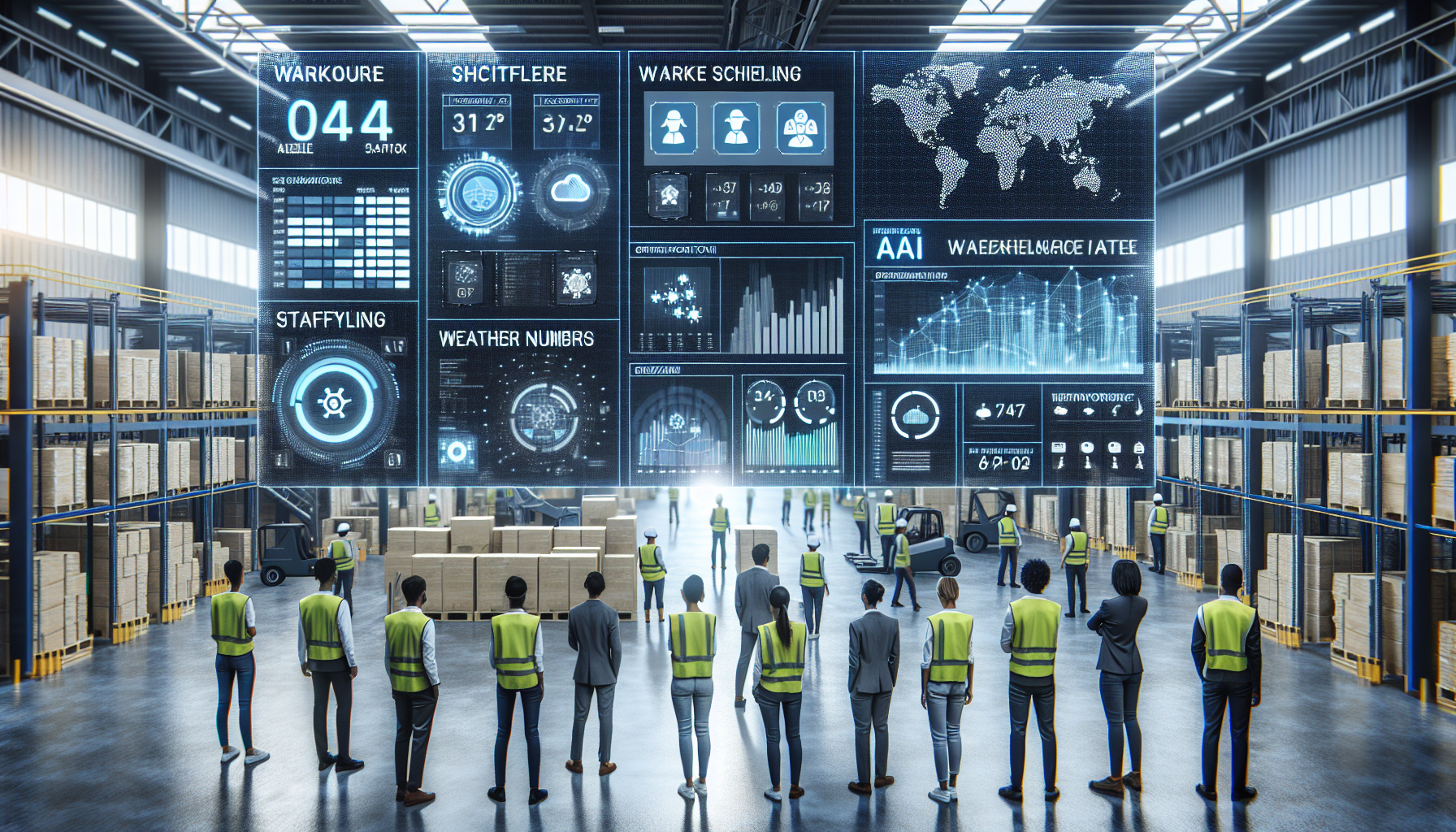
Most warehouses answer the staffing question the same way every week.
Check the forecast from the WMS. Look at last year's numbers. Add a buffer for uncertainty. Schedule the shift.
This approach treats labor planning as a math problem with stable inputs. It ignores everything that actually causes staffing plans to fail: the weather, local events, employee experience levels, upstream delays, and the dozen other variables that determine whether you'll have the right people in the right place.
AI agents handle labor planning differently. They don't just crunch numbers from a single system. They pull data from multiple sources, research external factors, reason through the tradeoffs, and communicate recommendations directly to the people who need to act on them.
Here's how that actually works.
The Real Cost of Getting Staffing Wrong
Before getting into how AI agents solve this problem, let's be clear about what's at stake.
Overstaffing a shift by 5 people costs you $600-800 in wasted labor. Do that twice a week across multiple facilities, and you're looking at $50,000+ in annual waste—just from having more people than you need on slow days.
Understaffing is worse. Orders back up. Overtime kicks in at time-and-a-half. Your best employees burn out from consistently working short-handed. They start looking for jobs elsewhere. Turnover costs 30-50% of an annual salary per departure.
And safety suffers. Understaffed operations are rushed operations. Rushed operations have more incidents. OSHA fines start at $15,000 per violation.
The goal isn't minimizing headcount. It's matching headcount to actual demand. Having exactly the people you need, when and where you need them.
Why Traditional Approaches Fail
Most operations attempt labor planning in one of three ways. None of them work well.
Historical averages. Last Tuesday needed 47 pickers, so this Tuesday gets 47 pickers. This ignores that last Tuesday had clear weather, no local events, and your most experienced team on shift. This Tuesday might be completely different.
WMS forecasts only. Your warehouse management system predicts order volume. But volume alone doesn't determine labor needs. A thousand single-line orders takes different labor than a hundred multi-line orders, even at the same unit count. The WMS doesn't know your team composition, equipment availability, or what's happening outside your walls.
Supervisor gut feel. Experienced supervisors develop intuition about staffing. But that intuition can't scale. It lives in their heads. When they're on vacation or move to a different facility, the knowledge goes with them.
The common failure mode is the same: these approaches use partial information. They can't see the full picture because the full picture exists across multiple systems, external data sources, and human judgment that's never been captured.
How an AI Agent Actually Does This
We've deployed an AI agent that handles labor planning autonomously. Not a dashboard. Not a report generator. An agent that analyzes data, researches external factors, and communicates directly with supervisors about staffing adjustments.
Let me walk you through exactly how it works.
Step 1: Load Context
The agent starts each planning run by checking its memory. What did it recommend for similar conditions in the past? How did those recommendations play out? Are there facility-specific constraints or preferences it needs to account for?
This memory is crucial. Without it, the agent would repeat mistakes. With it, the agent knows that the Columbus facility always needs extra coverage on Mondays because of a standing customer delivery. It remembers that the Fresno plant manager prefers two days' notice for staffing changes rather than same-day adjustments.
Step 2: Pull Internal Data
The agent gathers information from your operational systems:
From the WMS, it gets forecasted volume, order composition, and the mix of order types expected. A shift heavy on single-line picks needs different staffing than one heavy on full-case orders.
From the LMS, it gets historical productivity rates by order type, adjusted for employee experience levels. Not just average picks per hour, but realistic expectations given who's actually scheduled.
From the HRIS, it gets tomorrow's scheduled team: tenure, skill ratings, certifications. Seven new hires in their first 90 days operate at ~70% of an experienced picker's productivity. The agent accounts for this.
Step 3: Research External Factors
Here's where the agent goes beyond what traditional labor management software can do.
It checks the weather forecast. Not just "will it rain?" but "how does weather like this historically affect our operation?" A snowstorm means late arrivals and higher callout rates. The agent knows from past data that 4-6 inches of snow typically results in 23% of the workforce arriving late and an 8% increase in callouts.
It scans for local events. A Badgers basketball game downtown creates traffic that affects commute times. A job fair at the convention center might thin out the temp labor pool if you need same-day flex workers.
It monitors upstream conditions. Three inbound trucks scheduled to arrive at 6 AM, same time as the forecasted snow impact? That's a receiving crunch waiting to happen.
The agent synthesizes all of this into a staffing recommendation that accounts for conditions no spreadsheet would capture.
Step 4: Generate the Recommendation
The agent doesn't just produce a number. It explains its reasoning and gives supervisors confidence in the recommendation.
Here's an example of what this looks like when the agent identifies a staffing adjustment:
Hey Sarah,
Heads up for tomorrow's day shift at Building 4.
Volume looks normal, but I'm seeing a few factors that suggest we need extra coverage:
Weather impact: 4-6" of snow starting at 5 AM. Based on past storms, we typically see about 23% of the team arriving 30+ minutes late, plus a few callouts. I'd recommend scheduling 4 additional pickers to buffer this.
Team composition: We've got 7 associates in their first 90 days on tomorrow's shift. They're doing well, but still ramping on productivity. I've factored this into the capacity numbers.
One more thing: there's a job fair at Alliant Energy Center tomorrow, which sometimes affects temp availability. Might be worth confirming your staffing agency's capacity today in case we need same-day flex.
My recommendation: 18 pickers instead of the usual 14.
I can send schedule confirmations to your on-call list if you approve. Also happy to adjust the receiving team's start time to 7 AM if you want to avoid the worst of the commute impact—just let me know.
No jargon. No 47-page report. A clear situation, a specific recommendation, and options for action.
Step 5: Handle Responses
When Sarah replies, the agent processes the feedback.
If she says "Let's do 16 instead of 18—I think we can handle it," the agent acknowledges the decision, adjusts its records, and will compare the outcome to the original recommendation. Over time, it learns Sarah's risk tolerance and calibrates accordingly.
If she says "Go ahead and contact the on-call list," the agent can send shift confirmation texts to employees, remind them about the weather, and track who confirms availability.
If she asks "What if the snow is worse than forecast?" the agent can run the scenario: here's what happens at 6 inches versus 8 inches versus 10 inches. Here's when we'd need to escalate to additional coverage.
Step 6: Monitor and Adjust
The agent doesn't stop when the shift starts. It continues monitoring conditions and can send updates if the situation changes.
Snow starting earlier than forecast? The agent alerts Sarah with updated projections. Callouts higher than expected in the first hour? The agent can trigger outreach to backup workers before the situation becomes critical.
After the shift ends, the agent compares what actually happened to what it predicted. Did 18 pickers turn out to be the right call? Were there bottlenecks or excess capacity? This feedback sharpens future recommendations.
What This Looks Like Across a Network
Let me paint a picture of how this runs at scale.
Sunday evening, 6:00 PM. Before the week begins, the Labor Planning Agent has already:
- Analyzed conditions for 23 facilities across the network
- Identified 8 locations with significant variance between standard staffing and recommended staffing
- Composed and sent personalized messages to site supervisors
- Flagged 3 facilities where weather or events warrant extra attention from regional leadership
Monday morning, regional operations gets a summary: which sites are expected to run tight, which have excess capacity, and where cross-training or temporary transfers might help balance the network.
Throughout the week, the agent handles responses. Phoenix approves adding 2 pickers for Tuesday's heat advisory. Chicago pushes back on reducing headcount until after a scheduled inventory audit. Memphis asks for more detail on the traffic analysis. The agent handles each appropriately.
By Friday, the agent has prevented 4 understaffing situations that would have resulted in overtime, identified $12,000 in potential labor savings from overstaffed shifts, and learned new context about each facility's constraints and preferences.
No analyst spent days in spreadsheets. No regional manager had to chase down follow-ups. No staffing recommendations sat in someone's inbox until it was too late to act.
The Intelligence That Makes This Work
What separates an AI agent from a traditional forecasting tool is its ability to reason through complexity and communicate like a trusted team member.
Multivariate analysis. The agent weighs dozens of factors simultaneously—volume, order mix, weather, events, employee skills, equipment availability, historical patterns—and synthesizes them into a coherent recommendation. No human could do this analysis consistently for every shift at every facility.
Research capability. The agent can go find information it needs. Is there a Bears game that might affect Chicago traffic? What's the weather forecast for the next 72 hours? When does that seasonal volume spike typically start? The agent researches autonomously rather than waiting for someone to feed it data.
Contextual memory. The agent remembers past interactions, facility-specific constraints, and how its recommendations played out. It learns which supervisors prefer detailed analysis versus bullet points. It knows which facilities have quirks that affect staffing calculations.
Direct communication. The agent doesn't just generate reports and hope someone reads them. It sends messages to the right person, at the right time, with a clear ask. It handles responses, objections, and follow-up questions.
Getting Started
If you're running a warehouse operation, here's how to think about AI-driven labor planning:
Start with data visibility. AI agents can only optimize what they can see. If your productivity data is unreliable, your team composition isn't tracked, or your systems don't talk to each other, that's the first gap to close.
Connect internal systems. The agent needs access to your WMS for demand signals, your LMS for productivity data, and your HRIS for team information. Most modern warehouse systems have APIs that make this integration straightforward.
Enable external data. Weather forecasts, event calendars, traffic data—these inputs are freely available. The value comes from connecting them to your operational context.
Start narrow and expand. Pick one shift at one facility. Let the agent run for a few weeks. Observe how it handles edge cases and how supervisors respond to its communication style. Then expand to more shifts, more facilities, and eventually your full network.
The companies doing this well aren't treating AI agents as a replacement for supervisory judgment. They're treating them as a way to scale supervisory judgment across more shifts, more facilities, and more variables than any human team could track alone.
Labor planning is one application. The same architecture applies to safety coaching, quality investigations, equipment optimization, and dozens of other operational challenges where data exists, analysis is valuable, and human bandwidth is the constraint.
That's most of warehouse operations. The question is which problems you tackle first.
The Labor Planning Agent is one of several AI agents available through OneTrack's AiOn platform. Built on ground truth from sensors and connected to your WMS, LMS, and HRIS, AiOn agents handle staffing optimization, safety coaching, fleet sizing, and more. See AiOn in action →
Related Articles
- Agentic AI for Supply Chain - How AI agents transform supply chain operations
- How AI Agents Optimize Your Forklift Fleet - Another agent in action
- AI Agents for Warehouse Operations - The complete guide to AI agents
- AiOn: AI Agent Platform for Logistics - Deploy autonomous AI agents in your operation