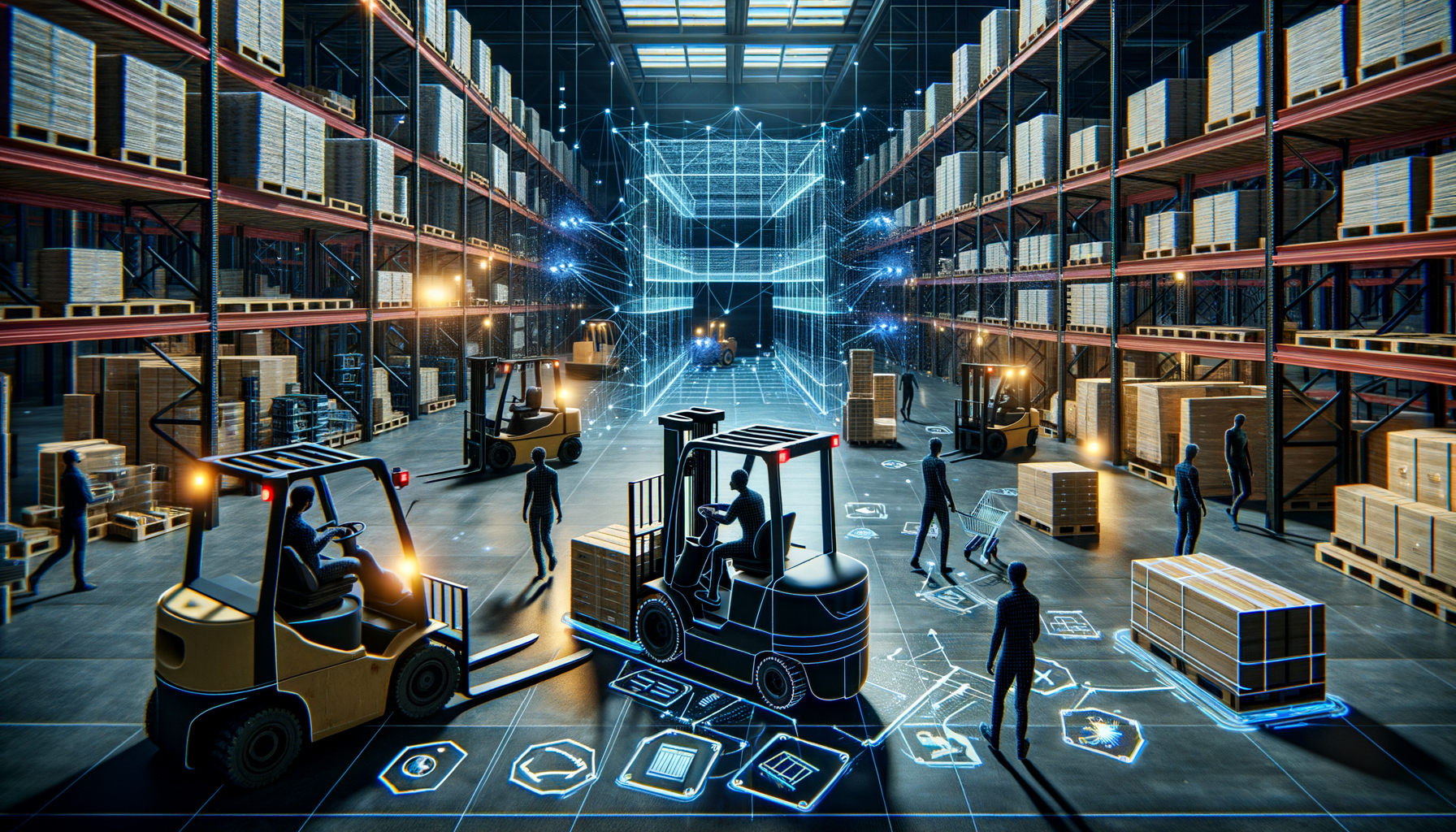
Most AI lives in the digital world. It reads text, writes code, analyzes spreadsheets, and generates images from prompts. It operates in a realm of pure information, where data arrives pre-packaged and the consequences of errors are measured in tokens, not injuries.
Physical AI is different. It must understand the real world: three-dimensional spaces, moving objects, human behavior, cause and effect. It processes raw sensory data and makes sense of environments that were never designed for machine interpretation. And when physical AI makes decisions, those decisions have real consequences for real people.
This is the next frontier. Not AI that reads about warehouses, but AI that understands them.
The Gap Between Digital and Physical Intelligence
The AI revolution of the past decade has been almost entirely digital. Large language models can write essays, summarize documents, and answer complex questions. Image generators can produce photorealistic pictures from text descriptions. These systems are impressive, but they share a fundamental limitation: they operate on abstractions.
When a language model processes the sentence "the forklift operator drove too fast around the corner," it understands the words and their relationships. It can generate similar sentences or answer questions about forklift safety. But it has no concept of what "too fast" actually looks like, how the physics of a loaded forklift differs from an empty one, or what subtle body language might indicate a distracted operator.
Physical AI bridges this gap. Instead of processing text descriptions of the world, it processes the world itself through cameras, sensors, and spatial reasoning. It learns not from datasets of human-written text, but from millions of hours of real-world observation. The result is artificial intelligence that can recognize situations, predict outcomes, and understand context in ways that purely digital systems cannot.
Why Warehouses Are the Proving Ground
Warehouses might seem like an unlikely place to develop cutting-edge AI. They are not glamorous. They do not capture headlines like autonomous vehicles or humanoid robots. But warehouses possess a unique combination of characteristics that make them ideal environments for physical AI to mature.
Structured Variability
A warehouse is not a chaotic environment. It has defined spaces, predictable traffic patterns, and consistent equipment types. Forklifts follow aisles. Products sit on racks. Workers perform recognizable tasks. This structure provides the scaffolding that AI needs to learn.
But within that structure, enormous variability exists. Every shift brings different operators with different skill levels. Product mix changes daily. Traffic patterns shift with seasonal demand. Equipment ages and behaves differently. Weather affects dock doors and floor conditions. A physical AI system must learn to recognize the underlying patterns while adapting to constant variation.
This combination of structure and variability creates the perfect training environment. The AI can learn generalizable patterns without being overwhelmed by chaos, then prove its robustness against endless real-world edge cases.
High Stakes Operations
Warehouse operations have clear, measurable outcomes. Safety incidents are documented. Productivity is tracked by the hour. Damaged products generate claims. This creates tight feedback loops that accelerate AI learning.
When a physical AI system flags a near-miss event, the validity of that flag can be verified. When it identifies a productivity bottleneck, the impact of addressing that bottleneck can be measured. When it predicts a quality issue, the downstream claim data confirms or refutes the prediction. Each cycle of prediction and verification makes the system smarter.
The stakes also ensure that the AI must work. A chatbot that occasionally hallucinates can still be useful. A physical AI system that misses safety events or generates false alarms will be removed. This pressure forces the development of robust, reliable systems rather than impressive demos.
Massive Visual Data
A single warehouse generates more visual data in a week than most AI training datasets contain. Dozens of vehicles, each with multiple camera angles, operating across multiple shifts, produce a continuous stream of real-world footage. This data captures the full spectrum of human behavior, from expert operators executing flawless procedures to rookies making predictable mistakes to veterans developing dangerous shortcuts.
This volume of data enables a different approach to AI development. Instead of carefully curating small datasets and hoping they represent reality, physical AI can learn from the full distribution of real-world events. It sees the common situations thousands of times and the rare situations hundreds of times. It develops intuition for what normal looks like and sensitivity to what abnormal looks like.
Clear Feedback Loops
In many AI applications, determining whether the AI made a good decision is difficult. Did the recommendation engine suggest the right product? Did the content moderation system make the right call? These questions often have subjective answers.
Warehouse operations provide objective feedback. The operator did or did not have an accident. The shipment did or did not arrive damaged. The productivity target was or was not met. This clarity allows physical AI systems to continuously calibrate themselves against ground truth, correcting errors and refining their understanding of what matters.
What Physical AI Can Actually Do
Physical AI represents more than better cameras or smarter alerts. It introduces capabilities that were previously impossible, changing how warehouse operations can be understood and managed.
Understanding Human Behavior and Intent
Humans communicate through more than words. Body language, movement patterns, timing, and spatial positioning all convey information. Physical AI can learn to read these signals.
An experienced supervisor can often tell when an operator is struggling before any metrics indicate a problem. The operator's movements become hesitant. Their scanning patterns change. They take longer on routine decisions. Physical AI can learn to recognize these same signals, extending that supervisory intuition across every vehicle on every shift.
This goes beyond detecting rule violations. The system can identify operators who are fatigued, confused, or rushing. It can recognize when someone is about to make a mistake, not just when they have already made one. This predictive capability transforms safety from reactive investigation to proactive intervention.
Recognizing Equipment, Products, and Environments
Physical AI develops a deep understanding of the operational environment. It learns to recognize different equipment types and their capabilities. It understands how a reach truck moves differently from a counterbalance forklift. It knows what a properly wrapped pallet looks like versus one that will fail during transport.
This recognition extends to environmental conditions. The system can identify debris on the floor, damaged racking, improper storage, and congested aisles. It can detect when dock conditions have changed or when traffic patterns indicate a developing bottleneck. Every element of the physical environment becomes legible to the AI.
Predicting Outcomes from Current Conditions
Perhaps the most valuable capability of physical AI is prediction. By observing thousands of situations and their outcomes, the system learns to recognize the precursors to both positive and negative events.
A near-miss today has a pattern. The operator who will have an accident next month is already displaying subtle warning signs. The process that will create quality issues during peak season is already showing stress under current loads. Physical AI can identify these patterns and surface them before they become problems.
This predictive capability inverts the traditional approach to operations management. Instead of investigating incidents after they occur and hoping to prevent recurrence, operations teams can address root causes before incidents happen. The focus shifts from reactive firefighting to proactive improvement.
Guiding Autonomous and Semi-Autonomous Systems
As warehouses adopt more automation, physical AI becomes the connective tissue between human and machine operations. It can monitor how autonomous systems interact with human workers, identifying potential conflicts before they occur. It can help autonomous systems understand the informal rules and social dynamics that human workers navigate intuitively.
Physical AI can also extend the capabilities of human operators. By providing real-time guidance based on current conditions, it can help operators make better decisions without requiring full automation. This hybrid approach captures many benefits of automation while preserving human judgment and flexibility.
The Training Challenge: You Cannot Simulate a Warehouse
Building physical AI requires solving a fundamental problem: where does the training data come from?
For digital AI, training data is abundant. The internet contains trillions of words of text, billions of images, and millions of hours of video. Researchers can download datasets and begin training models immediately. The data may be noisy and biased, but it exists in vast quantities.
Physical AI needs different data. It needs footage from inside actual operations, captured from the perspective of vehicles and equipment, labeled with the outcomes that matter. This data does not exist on the internet. It cannot be purchased from data vendors. It must be collected directly from real operations.
Simulation might seem like an alternative. Computer graphics can render realistic warehouse environments. Physics engines can model vehicle dynamics. But simulated data has fundamental limitations. No simulation captures the full complexity of human behavior. No physics engine perfectly models how a damaged floor affects forklift stability. No rendering system generates the visual artifacts that real cameras produce in challenging lighting conditions.
AI systems trained primarily on simulated data fail when deployed in real environments. They overfit to the clean, predictable patterns of simulation and cannot handle the messy reality of actual operations. The gap between simulation and reality is called the "sim-to-real" problem, and it has defeated many promising robotics and AI projects.
The only solution is real-world data, collected at scale, from diverse operations, over extended time periods.
Building Physical AI from Real Operations
OneTrack has spent years building the foundation for physical AI. Our sensor systems are deployed across hundreds of facilities, on thousands of vehicles, generating millions of hours of operational footage. This is not surveillance data collected incidentally. It is purpose-built training data captured with the hardware, perspectives, and labeling infrastructure that physical AI requires.
The scale matters. Rare events become statistically significant when you observe thousands of vehicles across thousands of shifts. The AI can learn from near-misses that occur once per thousand operating hours because we have accumulated millions of operating hours. Edge cases that would take decades to observe in a single facility appear regularly across our network.
The diversity matters too. Our data comes from 3PLs, manufacturers, retailers, and distributors. It spans cold storage and ambient facilities, multi-story distribution centers and ground-level warehouses, high-velocity e-commerce operations and slow-moving bulk storage. The AI learns patterns that generalize across operational contexts rather than overfitting to any single environment.
And the labeling matters. Raw footage becomes training data only when outcomes are attached. Every safety event, productivity variance, and quality issue in our system is linked back to the operational context that preceded it. This creates a dataset where the AI can learn not just what things look like, but what they mean.
From Understanding Transactions to Understanding Operations
Traditional warehouse technology understands transactions. The WMS knows that a pick occurred at a certain time in a certain location. The LMS knows that a worker completed a task in a certain duration. The telematics system knows that a vehicle traveled a certain distance.
But transactions are shadows of operations. They capture what happened without explaining how or why. They provide timestamps without context. They enable measurement without understanding.
Physical AI understands operations. It sees the pick happen and understands the sequence of movements, the challenges the operator faced, the efficiency of their approach. It watches the task completion and identifies the factors that made it fast or slow. It observes the vehicle travel and recognizes the traffic conditions, near-misses, and behavioral patterns along the route.
This deeper understanding unlocks new capabilities. When productivity drops, physical AI can identify the specific operational causes. When safety incidents occur, it can trace the behavioral patterns that led to them. When quality issues emerge, it can pinpoint the process breakdowns responsible.
Operations leaders gain a new kind of visibility. Instead of dashboards showing what happened, they receive intelligence explaining why and guidance on what to do about it.
The Future of Physical AI in Logistics
We are at the beginning of a fundamental shift in how logistics operations are understood and managed. Physical AI will mature from detecting events to predicting them, from describing situations to prescribing actions, from assisting human decision-makers to autonomously handling routine operational decisions.
The next generation of physical AI will integrate understanding across multiple domains. Safety, productivity, and quality will be analyzed together as interconnected aspects of operational performance rather than separate metrics tracked by separate systems. The AI will recognize that pushing productivity too hard creates safety risk, that safety incidents disrupt productivity, and that both affect quality.
Physical AI will also enable new forms of human-machine collaboration. Instead of replacing human judgment, it will augment it. Supervisors will work with AI systems that notice what they miss and remember what they forget. Operators will receive guidance calibrated to their individual skill levels and learning needs. Engineers will have access to insights that would take years of manual observation to develop.
The companies that build expertise in physical AI now will have significant advantages as these capabilities mature. They will possess the data, the systems, and the organizational knowledge to deploy physical AI effectively. They will understand how to integrate AI insights into operational workflows. They will have learned what physical AI can and cannot do, and how to use it appropriately.
The warehouse of the future will not just be automated. It will be understood, by AI systems that see operations with a depth and consistency that humans cannot match. Physical AI is the technology that makes that understanding possible.
And that future is not distant. It is being built now, one facility at a time, from the real-world data that only actual operations can provide.
Related Articles
- Computer Vision for Warehouses - The technical foundation
- How We Built an AI That Understands Warehouses - Training on real operations
- Forklift Telematics vs Vision AI - Why physical understanding matters
- The Warehouse Operating System - Physical AI in the enterprise stack